Why You Might Feel Cold More Easily Now
By Millie · July 20, 2026
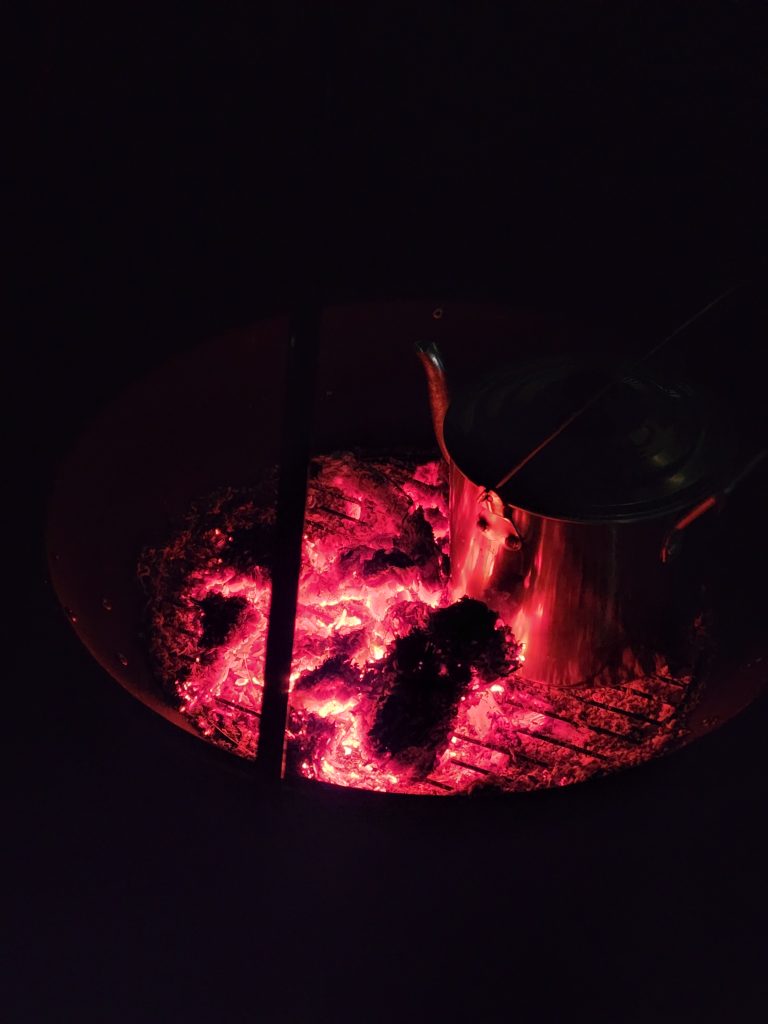
There is a spirit who lives in every hearth, real or improvised, wood fire or heat lamp or the single bar radiator someone’s nana left behind. Her job has never changed. She notices when a body wants warmth, and she insists, gently but completely, that it get some. She has never once checked the forecast first.
The Cold Doesn’t Care What You’re Used To
Twelve degrees in Reykjavik and twelve degrees in South East Queensland are, technically, the same twelve degrees. Nobody’s body reads it that way. Ours have spent six months learning to survive summer, which means learning to want less warmth, less layering, less anything touching the skin. Come July, that same skin registers a mild evening as an emergency.
Whatever anyone’s Victorian relatives might say, this is biology, not softness. Comfort research backs it up plainly: people who live in consistently warmer climates come to expect and prefer warmer indoor conditions than people who live in cold ones, and their sense of “comfortable” shifts to match the climate they’re acclimatised to. ¹ Recent work specifically on humid subtropical climates found the same thing again: the comfort zone sits higher, and the shift is measurable, not imagined. ² You’re responding exactly as a subtropical body is built to, nothing dramatic about it.
What the Hearth Spirit Actually Wants
She’s not interested in your central heating system, mostly because you probably don’t have one. What she wants is smaller and more specific:
A blanket that lives on the back of a specific chair and nowhere else. A lamp instead of the overhead light, because overhead light has never once made a room feel like a place to stay. Something warm in a mug, doesn’t matter what, held with both hands for longer than strictly necessary. Socks that don’t match anything, worn anyway.
None of this needs to be styled for anyone else’s benefit. The hearth spirit has no interest in how the blanket photographs.
The Bit Where the Research Agrees With Her
It would be easy to write off deliberate coziness as a wellness trend with good branding, and plenty of it is. But there’s genuine qualitative research on people building small, repeated rituals of comfort, candles, warm drinks, a defined cozy corner, and finding it meaningfully supports their sense of psychological wellbeing and their capacity to cope with hard stretches. ³ That ritual is functional, not decorative.
Nobody is coming to check whether your twelve degrees counted, least of all the hearth sprit. She’s already found her spot by the lamp, wrapped in the good blanket, unbothered by any thermometer. Put the blanket on the good chair and leave it there through summer, out of spite.
¹ de Dear, R. and Brager, G., 1998. Developing an Adaptive Model of Thermal Comfort and Preference, ASHRAE Transactions, 104(1). This is a 1998 study, but it remains the foundational, most-cited work establishing that thermal comfort expectations shift with climate.
² Thermal sensitivity and adaptive comfort in mixed-mode buildings in humid subtropical climate, Building Research & Information, 2023.
³ Pitts, L.N. et al., 2024. Qualitative study on hygge practices and psychological wellbeing/coping, published in a peer-reviewed nursing journal (SAGE).